
This essay was originally written for my Modern Art History course at CCAC.
“Still Life with Fruit” by Jan Van Os: a Critique
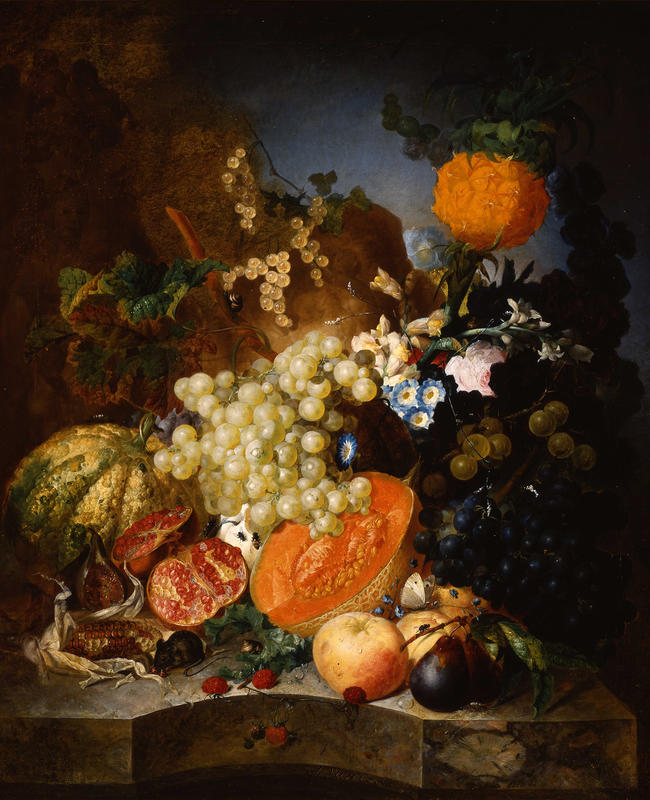
At the Frick Art Museum lives Jan van Os’s Still Life with Fruit, painted with oil on canvas in 1769, then purchased in 1896 by Henry Clay Frick. This Dutch Baroque piece features an impossible, abundant arrangement of flowers and fruits piled atop a stone ledge, with a glowing and shadowy background. I’ve always been attracted to still lifes. Their quietness, calmness, and the way they capture the story of a single moment in time uniquely from other genres. Every painting—every still life—has a story to tell. The longer I looked, I discovered more details, more tiny secrets. This still life is unique. This painting had something to tell me, and I couldn’t walk away.
Still Life with Fruit is protected by a beautiful ornate gold frame. It is approximately two feet by two feet. The scale is true to life, as if you could reach in and pluck one of those crunchy grapes off the vine. An off-center stone ledge holds the fruit arrangement that could never exist in real life. The arrangement glows with warm, bright reds and oranges, and dark blues and greens. It is contrasted by a cool, dull, muddy background that adds to the liminal feeling. Light and shadow form a crescent curve, and it is difficult to tell where the light source is coming from. A round, orange pineapple reaches upward like a scepter. Around the arrangement, a gourd, a pomegranate, figs, peaches, and berries all sit slightly off-kilter. The smaller details appear the longer you look: the water droplets, the mouse helping himself to some corn, the snails scattered about, a delicate moth, a gathering of bees, some house flies; and, if you look closely, tiny, fuzzy caterpillars. This still life isn’t still at all—it is teeming with movement. In the faint, muddy background, something is just barely visible. A face? Or is it a case of pareidolia?
The painting first draws you in with its unique colors. Van Os uses warm reds and oranges, and earthy blues and greens from the fruits against a muted background. Nearly everything in the painting is round and smooth—almost entirely organic. Nothing is harsh or angular; even the stone ledge is curved inward instead of a harsh, straight line. The textures vary—from the smooth, glassy grapes to the lumpy, rough gourd. Notice the soft peaches, the delicate, papery wings of the moth, the juicy pomegranate, the rippled leaves bunched together above the gourd, the rough skin and soft, inner flesh of the cantaloupe, and the fuzzy little hairs of the caterpillars. The water droplets look as if you could lick them off the canvas.
The composition is noticeably off-center. The whole arrangement leans slightly to the right, which caused me to shift my weight without realizing it. The pineapple sits high, leaning at a slight angle. The dark grapes heavily anchor the whole arrangement, while the white grapes cascade between everything and hold the whole piece together. The impossible light source and the visible edge of the stone make you feel unsettled, backed into a corner. Your eyes move in a circular motion, all over the painting. The painting keeps moving the longer you look, as if van Os is choreographing you from beyond the grave.
Take a step back, and the composition reorganizes itself. The white grapes are the center of the painting’s gradient, the brightest point between a slow, luminous fade. But, at the true center of the canvas is a small blue and white flower, silently looking to the left, half shaded by the grapes. Step back further and the shape of the fruit arrangement transforms. The darker part of the fruit arrangement seems to be cradling the lighter part—because it is. The whole arrangement is in the shape of a cradle, and the white grapes act as a blanket spilling out. The pineapple becomes a hanging mobile.
Looking closely once more, in the dark, muddy background to the left, half hidden behind the leaves: the face and torso of a woman. An infant in her arms. It isn’t pareidolia. That is a Madonna and Child—the most hidden secret of this painting. Watching, staring right at you, very nearly unseen. Paying mind again to the colors: this hidden Nativity scene isn’t a celebration. It’s a vigil. The painting tells a story of a mother and child who did not survive. That circular pattern becomes a gesture at the circle of life. This is a painting of abundance and mortality at the same time. The mother and child watch over the arrangement of beautiful, perishable things, while the fresh fruit is already being eaten, and the center flower looks toward them.
I thought I was done with this painting when I left the Frick. I wasn’t. It felt as though there was still something the painting wanted to tell me. Writing about it, the details kept surfacing. Now I understand why I couldn’t walk away. This painting is anything but quiet or calm. But it is patient. It has been waiting 250 years for those who are interested enough to let it reveal its story. Still Life with Fruit comes from a tradition that grew from the 17th century Dutch Republic, when Protestant patrons had mostly turned away from religious art in favor of still lifes, portraits, and genre scenes. Van Os carries the vanitas still life tradition in his own way with his vivid colors and details; with impossible arrangements and illumination. This painting is a cross-centuries conversation about life and mortality. It is a still life that is anything but still. It is easy to call this seemingly simple breakfast room painting a masterpiece.


